

Developers plan a launch around the sales team. The marketing budget, the broker event, the number of agents on the floor. Then the launch goes well, and three weeks later the contracts desk is buried. The workload of a launch does not stay in sales. It moves down the line, and the team has to move with it.
The numbers below are an example, not a benchmark. Replace them with your own and the method still works.
The example
A mid-sized developer launches a 300-unit tower. Most of the units sell through brokers in the first six weeks. Buyers pay a booking amount, then follow a construction-linked payment plan until handover in three years.
Weeks 1 to 6: sales
At launch, the work is enquiries, offers and bookings. If a few thousand leads arrive from ads, portals and brokers, someone has to check each one for duplicates, assign it and follow up within hours. Brokers ask for availability and offers all day. Every booking needs a unit hold, a payment and the buyer's documents.
This is the phase everyone plans for. The common mistake is to staff it with salespeople and let them do the admin. Salesforce's research found reps spend about 28% of their week actually selling. In a launch, every hour an agent spends retyping a passport or chasing a broker for a document is an hour not spent closing.
Weeks 2 to 10: contracts and registration
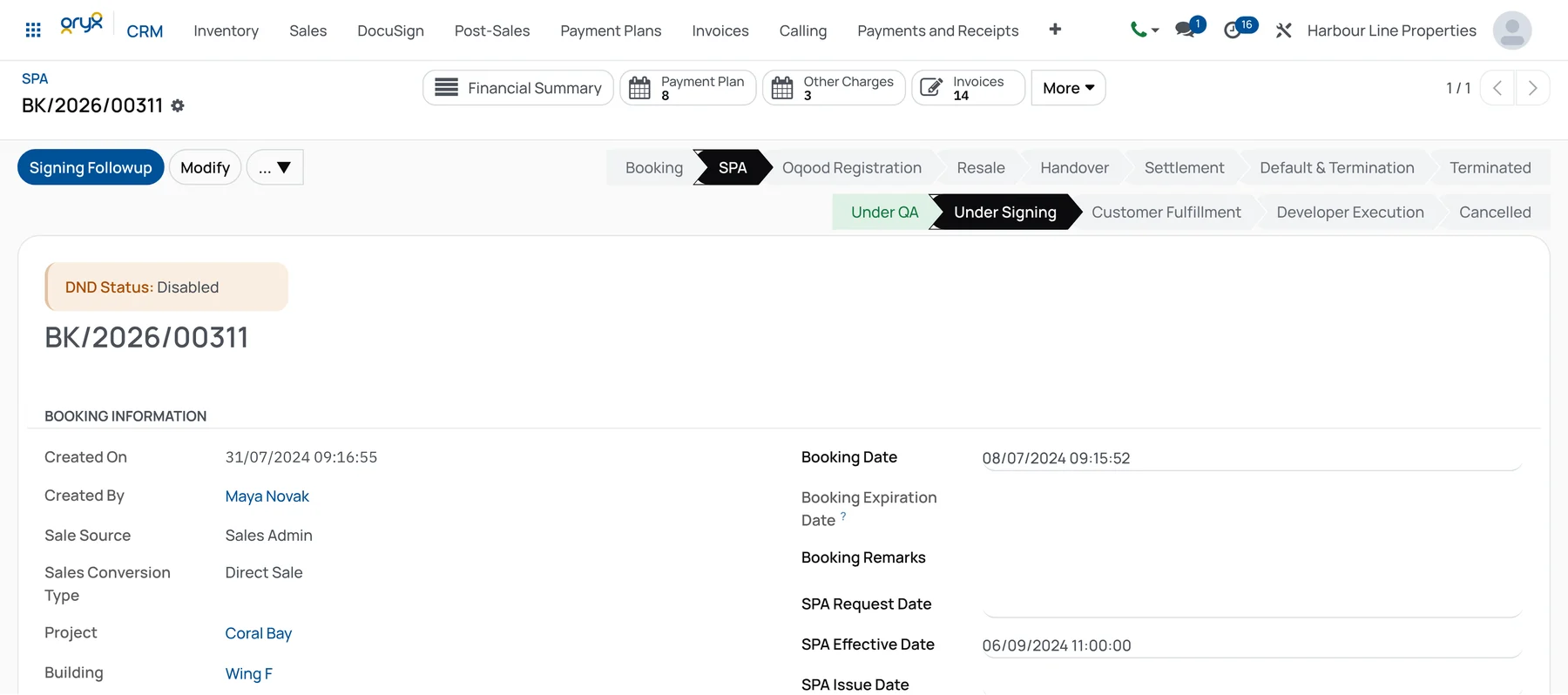
Each booking becomes a reservation agreement and an SPA, with signatures in the right order. Then registration: in Dubai, off-plan sales are recorded in the interim register through Oqood, which needs complete buyer documents and payment of the fees.
Three hundred bookings mean three hundred SPAs and three hundred registrations, most of them arriving within a few weeks of each other. This is where launches stall. One person preparing SPAs by hand, at even a few a day, needs months to clear the queue, while buyers wait and ask why.
Month 2 onwards: collections
From the first instalment, collections starts and never stops. Three hundred buyers on construction-linked plans means a steady stream of invoices, receipts, reminders, bounced cheques and requests to reschedule. The work is lighter per buyer than a sale, but it lasts for years.
Year 3: handover
At completion, the same 300 buyers need handover letters, final payments, mortgage releases, snagging inspections, defect fixes and key appointments, usually inside a few months. It is a second launch, without the marketing budget.
Brokers change the shape of the peak
When most units sell through agencies, the launch looks calmer on the sales floor and busier everywhere else. Brokers send bookings in bursts, often late in the day, each with documents in a different format. Someone has to check that the agency is registered, that the buyer was not already in the system through another channel, and that the commission terms match the agreement. A strong broker launch can bring as much admin to the back office as a busy walk-in launch brings to the sales floor, just in a different place.
A simple way to plan
Instead of asking how many people the launch needs, ask how many hours each stage needs, and when.
- 01List the tasksPer unit at each stage: lead checks and follow-ups, offer, booking, KYC, SPA, registration, each instalment, handover.
- 02Time themTime a few real cases. The numbers are usually higher than people expect.
- 03Multiply and spreadMultiply by units and put the hours on a calendar. The peaks show where you need people, and when.
- 04Mark what a system can takeDuplicate checks, schedule generation, invoice creation, reminders and document checks are good candidates.
Often, the peak that surprises a team is not the sales floor. It is contracts and registration in the weeks after a strong launch, and collections a few months later.
To give a sense of scale, the Oryx impact calculator counts the routine paperwork a 300-unit project creates over a three-year build, using today's averages across Oryx. It comes to about 1,827 hours, before anyone calls a single lead.
| Task | Per unit | Minutes each | Hours for 300 units |
|---|---|---|---|
| Invoices and receipts | 37.3 | 5 | 933 |
| Statements of account | 17.4 | 5 | 434 |
| SPAs | 0.98 | 45 | 220 |
| Monthly project reports | 36 per project | 240 | 144 |
| Payment reminders | 1.9 | 10 | 96 |
| Total | 1,827 |
What this means for the team
Move people with the work. Sales coordinators who supported the launch can move to the contracts desk for the weeks after it, if they have been trained and the process is written down.
Protect sellers from admin. Every task you take away from sales during the launch turns into more conversations with buyers.
Plan handover early. Three years sounds far away. It is not, and the people who know the buyers best are the ones who should plan it.
The right number of people for a 300-unit launch depends on how much of the routine work they still do by hand. Take that work away and the same team can handle more launches, with fewer late nights after each one.
Sources
Written by the Oryx team: people who ran sales, collections and handover at UAE developers before building Oryx. Questions or a different view? Email sales@oryx-me.com.