

Gulf proptech has had a busy two years. Tokenised property, record funding rounds for property portals, mortgage marketplaces and a government strategy that puts technology at the centre of the market's growth. Most of that attention is on buyers and investors. Developers are spending their technology budgets somewhere else.
Where the headlines are
In March 2025, the Dubai Land Department launched the pilot of its Real Estate Tokenisation Project, which records fractional ownership of title deeds on a blockchain. By May 2025, investors could buy tokenised shares in Dubai homes through a licensed platform, from a few thousand dirhams.
Amid rapid technological advancements and the increasing reliance on digital solutions, real estate tokenisation emerges as a revolutionary tool driving fundamental change in the real estate sector. By converting real estate assets into digital tokens recorded on blockchain technology, tokenisation simplifies and enhances buying, selling, and investment processes.
Funding followed the consumer side too. Wamda's review of 2025 put proptech as the second most funded sector in the region, with about USD 1 billion raised across 36 start-ups. Most of that went to one property portal, Property Finder, which raised about USD 775 million in two rounds.
The government's direction is clear. The Dubai Real Estate Sector Strategy 2033, announced in October 2024, aims for a 70% rise in transactions, home ownership of 33% and a real estate market worth AED 1 trillion, with technology named as one of the ways to get there.
- Dubai Real Estate Sector Strategy 2033 announced, aiming for a real estate market worth AED 1 trillion.
- The Dubai Land Department launches the pilot of its Real Estate Tokenisation Project.
- Investors can buy tokenised shares in Dubai homes through a licensed platform.
- UAE e-invoicing starts for businesses with revenue of AED 50 million or more.
Where developers are spending
Ask the people who run sales and operations at a UAE developer what they need, and a different list comes up. It is less exciting and more urgent.
- Lead managementAds, portals, brokers and walk-ins in one pipeline, checked for duplicates, with the cost of each lead visible. With fewer launches this year, every lead counts for more.
- Sales operationsLive inventory, holds, offers, bookings and contracts on one record, so a unit cannot be sold twice and an SPA does not wait a week for data.
- Collections and escrowSchedules, receipts, cheques and reminders, with every receipt assigned to the right project. Buyers who signed in a hot market need more attention in a calmer one.
- Buyer apps and portalsUnit, payments, documents and construction progress on the buyer's phone. Every question answered in the app is a call the team does not take.
- Handover toolsSnagging on a tablet, room by room, with photos and defect lists that go straight to the contractor. With record completions, handover is a project of its own.
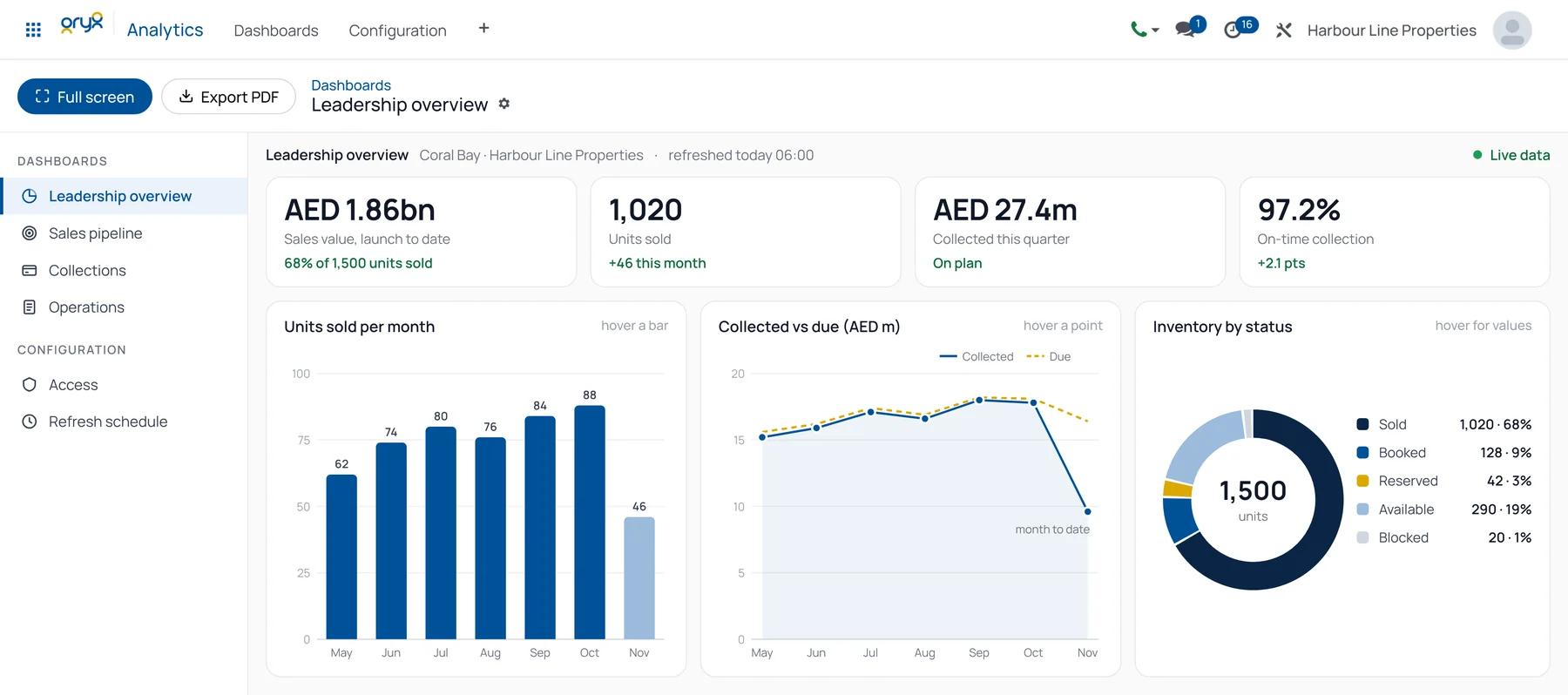
- DashboardsOne view of sales, collections and handover for management, updated daily, instead of a weekly pack assembled by hand.
- E-invoicingFrom 2027, thousands of instalment invoices a year, each one right where it is created.
Why now
Three forces are pushing developers to spend on operations rather than on shiny tools.
Margins are under watch. With fewer launches in 2026, boards are asking what each project costs to sell and to run. The answer lives in operational data that many developers still keep in spreadsheets.
Regulation keeps adding steps. Escrow reporting, registration, anti-money laundering checks, data protection and now e-invoicing. Each one adds work that is hard to do well by hand.
Buyers compare. A buyer who has had a smooth experience with one developer expects the same from the next. Slow answers about payments and handover dates now cost reputation, and reputation sells the next launch.
| Question | The headlines | Developer budgets |
|---|---|---|
| Who does it serve? | Buyers and investors | Sales, collections, customer service and handover teams |
| What gets bought? | Tokenised title deeds, portals, mortgage marketplaces | Leads, sales operations, collections, buyer apps, handover, dashboards, e-invoicing |
| What decides it? | Funding rounds and attention | Margins, regulation and what buyers have come to expect |
How developers are buying
The way developers buy software is changing too. Few want a single large project that replaces everything at once. Most start with the solution that hurts most, often collections or sales operations, and add others once the first one works. They want systems that run in the cloud, with data hosted close to home, local support in their time zone and people who understand Oqood, escrow and post-dated cheques without a long explanation. And they increasingly ask for one record from enquiry to handover, rather than a separate tool for every department, because every gap between tools becomes a spreadsheet.
What to watch
Tokenisation will grow, and portals will keep raising money. Those are good for the market. But the developers who come out of this cycle strongest will be the ones whose own operations run on live data: who know what is due, what is late and what is ready to hand over, without asking.
That is less exciting than a blockchain title deed. It is also where most of the time and money in a developer's business goes.
Sources
- Dubai Land Department: Dubai Land Department launches pilot phase of the Real Estate Tokenisation Project (March 2025)
- Dubai Media Office: Dubai Real Estate Sector Strategy 2033 (October 2024)
- Wamda: 2025 year in review, investments in MENA
- KPMG: UAE phased implementation of e-invoicing beginning January 1, 2027 (July 2026)
Written by the Oryx team: people who ran sales, collections and handover at UAE developers before building Oryx. Questions or a different view? Email sales@oryx-me.com.