

Two sets of numbers describe Dubai's off-plan market this year, and they point in different directions. One says the market has never been bigger. The other says the launch machine has slowed sharply. Both are true, and together they change what a developer's team spends its week on.
A record year behind us
The Dubai Land Department's annual review counted 270,328 real estate transactions in 2025, worth AED 917 billion. Both figures were up 20% on 2024. Off-plan made up 63.3% of investment activity, up from 61.0% the year before.
That is the stock of work still in the system today. Every off-plan sale signed in 2024 and 2025 is now a buyer on a payment plan, an SPA that was registered or still needs to be, and a handover date somewhere in the next few years.
Fewer launches in 2026
The first half of 2026 looked very different. Cavendish Maxwell counted about 28,000 new units across 124 launches, against 102,000 units across 410 launches in the first half of 2025. Cushman & Wakefield put the fall in new apartment launches at around 58% year on year and villa launches at 78%, as developers became more selective in softer conditions and amid regional uncertainty.
H1 2025H1 2026
Units launched
Projects launched
Show the numbers
| H1 2025 | H1 2026 | |
|---|---|---|
| Units launched | 102,000 | 28,000 |
| Projects launched | 410 | 124 |
Source: Cavendish Maxwell, H1 2026 residential report
Prices did not collapse with launches. The market moved into what most research houses describe as a more balanced phase, with buyers taking longer to decide and comparing more projects before they commit.
Dubai’s residential market is showing clear signs of transitioning to a new cycle following exceptional levels of activity over the last two years. The fundamentals that drive real estate demand in the emirate remain intact, but the near-term outlook is being shaped by a combination of factors – including the impact of fewer launches, regional uncertainty and a broader normalisation in buyer activity – that are likely to influence transaction levels and price performance.
A record number of handovers
At the same time, completions are running at a record pace. Cavendish Maxwell counted 24,800 new homes delivered in Dubai in the first half of 2026, and more are scheduled for the second half. Their summary of the shift is a good one: the market is moving from launch-led to delivery-driven.
For an operations team, this is the headline. The work has not shrunk. It has moved down the line.
What changes for a developer's team
Sales gets fewer, harder launches. With fewer projects coming to market, each launch carries more weight. Marketing budgets are watched more closely, and the cost of a wasted lead shows up quickly. Duplicate leads, slow first replies and brokers working the same buyer cost more when there are fewer chances to recover.
Collections carries the risk. Thousands of buyers are mid-way through payment plans signed in a hotter market. In a calmer market, some will pay late and some will ask to reschedule. The collections desk needs a short list of who is due and who is overdue each morning, with the full history on screen, rather than a month-end reconciliation.
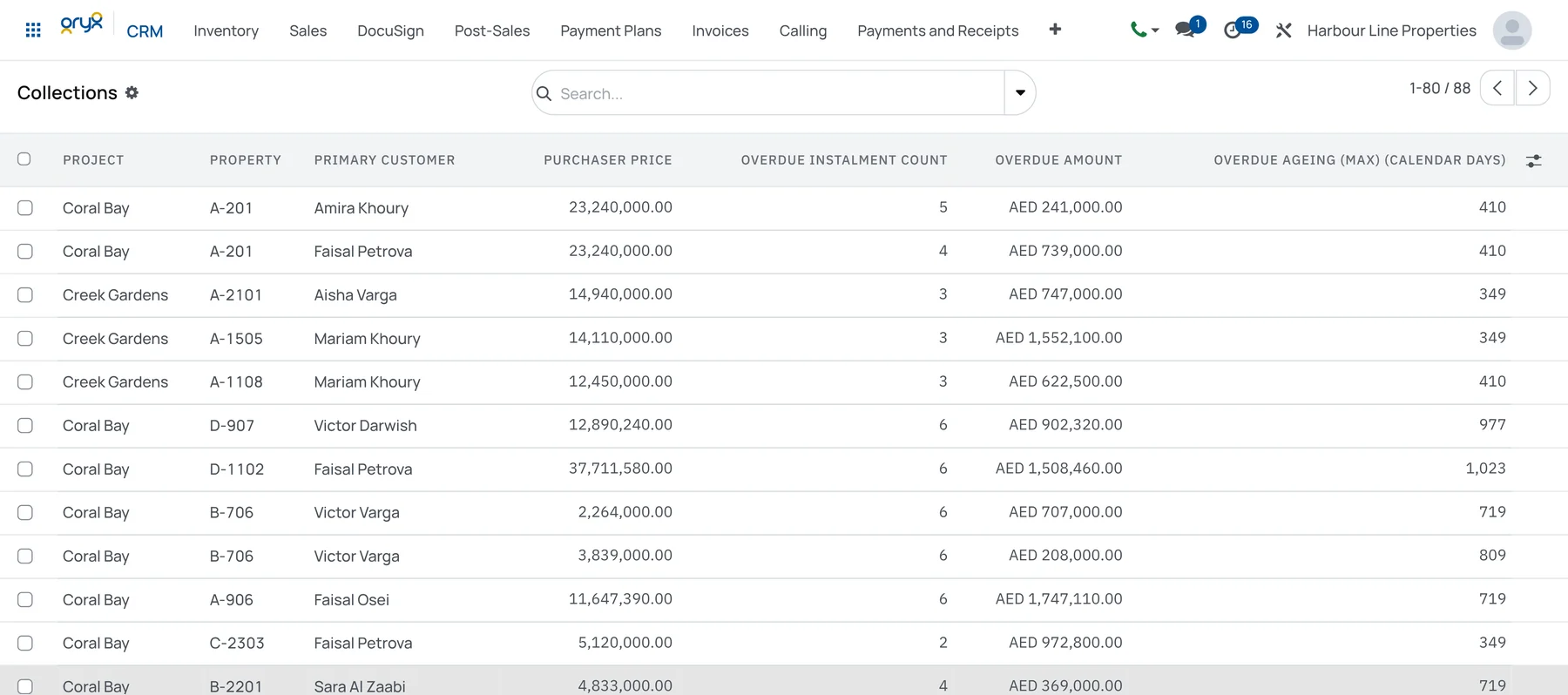
Handover becomes a project in itself. Handover letters, snagging, final payments, mortgage releases, service charge accounts and key appointments all land in the same months. A team that was sized for launch season now faces handover season, often with the same people.
Leadership wants one view. When the market turns, the first question from the board is simple: how much is due, how much is late, and which projects are at risk. If the answer takes three days and four spreadsheets, the team spends launch-season effort on reporting instead of on buyers.
Brokers need clearer rules. With fewer new projects to sell, agencies concentrate on the launches that are open, and the same buyer can reach a developer through two or three of them. Who registered the buyer first, which offer was sent and when commission falls due all need a clear answer before the launch, not after it. Disputes with brokers cost more than money when the market is quieter, because the developer needs those agencies for the next launch.
| Team | In a launch-led market | In a delivery-driven market |
|---|---|---|
| Sales | Many launches and a high volume of leads | Fewer, harder launches; every lead counts for more |
| Collections | New payment schedules being set up | Thousands of buyers mid-plan; more late payments and requests to reschedule |
| Handover | A few completions a year | Letters, snagging, final payments and keys landing in the same months |
| Leadership | Weekly sales figures | Due, late and at-risk balances by project, every day |
| Brokers | Many projects to sell | The same buyer through several agencies; who registered first matters |
Questions to ask this quarter
- How many of your buyers have an instalment due in the next 90 days, and how many are already late?
- How many units are due for handover in the next 12 months, and is anyone planning that work today?
- How long does it take your team to answer "what is our overdue balance by project"?
- If launches stay slow next year, which roles could move from sales support to collections and handover?
What to watch next
Third-quarter figures arrive in October and will show whether the slowdown in launches has reached sales. Whatever they say, the pipeline of buyers already on payment plans and units already due for completion is set. Developers who plan their teams around that pipeline, rather than around the launch calendar, will feel the change least.
Sources
- Dubai Land Department: Dubai Real Estate Market, Annual Data Review 2025
- Cavendish Maxwell via Zawya: Dubai adds 24,800 new residential units in H1 2026 as market shifts from launch-led to delivery-driven
- Cushman & Wakefield: Dubai property market enters more balanced phase as buyers and tenants gain ground
Written by the Oryx team: people who ran sales, collections and handover at UAE developers before building Oryx. Questions or a different view? Email sales@oryx-me.com.